
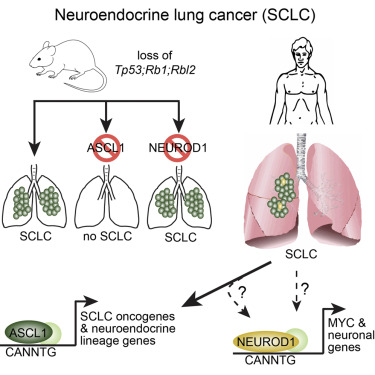
 Lung cancer is the leading cause of cancer‑related mortality worldwide. It is generally divided into two broad histological classifications: small cell lung cancer (SCLC) and non‑small cell lung cancer (NSCLC). SCLC is particularly aggressive and has been further subdivided by biological heterogeneity. Subtypes of SCLC have recently been described based on expression distinct transcriptional regulators. These subtypes were labeled as SCLC‑A expressing achaete‑scute homolog 1 (ASCL1), SCLC‑N expressing neurogenic differentiation factor 1 (NeuroD1), SCLC‑Y expressing yes‑associated protein 1 (YAP), and SCLC‑P expressing POU class 2 homeobox 3 (POU2F3). ASCL1 and NeuroD1 drive a neuroendocrine phenotype through regulation of distinct genes. DLL3, an inhibitor of NOTCH signaling, is upregulated by ASCL1. NCAM1 (neural cell adhesion molecule, CD56) is an adhesion glycoprotein that mediates neuronal attachment, neurite extension, and is a marker for the neuroendocrine phenotype. Thyroid transcription factor 1 (TTF‑1), a member of the NKX homeobox transcription factor family, is expressed in malignant tumors of the thyroid and lung, and it is commonly used as a marker for both primary and malignant lung cancers. Enolase‑2 is a glycolytic enzyme that is involved in the conversion of 2‑phosphoglycerate to phosphoenolpyruvate. Research studies have shown elevated levels of neuro‑specific enolase‑2 in neuroblastoma and SCLC. Chromogranin A (CHGA) is a member of the chromogranin/secretogranin family of neuroendocrine secretory proteins. It is expressed in the secretory vesicles of neurons and endocrine cells. CHGA is also useful as a serological and immunohistological marker for the presence of neuroendocrine tumors from various tissue sources. POU2F3 and YAP drive non‑neuroendocrine phenotypes. POU2F3 is normally selectively expressed in chemosensory tuft cells, and SCLC expressing POU2F3 resemble that cell type. YAP is widely recognized as a key mediator of the Hippo growth signaling pathway. Expression of these key biomarkers in SCLC are thought to help predict therapeutic treatment.
| Target | Catalog# | Product Name | Reactivity | Application |
|---|---|---|---|---|
| ASCL1 | APRab07210 | ASCL1 Rabbit Polyclonal Antibody | Human,Mouse,Rat | WB,IHC,ICC/IF,ELISA |
| NeuroD1 | AMRe14605 | NeuroD1 (11M3) Rabbit Monoclonal Antibody | Human,Mouse,Rat | WB,IHC,FC,IP,IF‑P |
| POU2F3 | AMM83544 | POU2F3 Mouse Monoclonal Antibody | Human | IHC |
| TTF1 | AMRe21095 | TTF1 Rabbit Monoclonal Antibody | Human,Mouse,Rat | WB,IHC,ICC/IF,ELISA,IP |
| DLL3 | AMM82852 | DLL3 Mouse Monoclonal Antibody | Human, Rat | WB,IHC,ICC,ELISA,FC |
| NCAM1 | AMRe86340 | NCAM1 Rabbit Monoclonal Antibody | Mouse,Rat | WB,IHC,ICC/IF,FC,IP |
| NSE | AMRe14909 | NSE (9L10) Rabbit Monoclonal Antibody | Human,Mouse,Rat | WB,ICC/IF,FC,IP |
| CHGA | AMM82506 | CHGA Mouse Monoclonal Antibody | Human | WB,IHC,ELISA,FC |
Related Products
Super-sensitive ECL chemiluminescent reagent
References
- ASCL1 and NEUROD1 Reveal Heterogeneity in Pulmonary Neuroendocrine Tumors and Regulate Distinct Genetic Programs. Borromeo MD, et al. Cell Rep. 2016. [PMID: 27452466]
- Global Cancer Statistics 2020: GLOBOCAN Estimates of Incidence and Mortality Worldwide for 36 Cancers in 185 Countries. Sung H, et al. CA Cancer J Clin. 2021. [PMID: 33538338]
- SCLC Subtypes Defined by ASCL1, NEUROD1, POU2F3, and YAP1: A Comprehensive Immunohistochemical and Histopathologic Characterization. Baine MK, et al. J Thorac Oncol. 2020. [PMID: 33011388]
- Serum neuron‑specific enolase and immunohistochemical markers of neuroendocrine differentiation in lung cancer. O'Shea P, et al. Ir J Med Sci. 1995. [PMID: 7890531]
- Small cell lung cancer: Subtypes and therapeutic implications. Wang WZ, et al. Semin Cancer Biol. 2022. [PMID: 35398266]