
Protein Glycosylation Antibody
A distinct form of protein glycosylation, β-D-N-acetylglucosamine (GlcNAc) moieties can be added to serine or threonine residues of proteins. This differs from other glycosylation forms, as it typically is a single moiety rather than the complex branched sugars that are more commonly studied. It is thought that these modifications happen in a much more dynamic cycle reminiscent of phosphorylation modifications. GlcNAc modified proteins are found in the cytoplasm and nucleus. They are modulated by means of specific O-GlcNAc transferases (OGT) as well as GlcNAcase activity that can be inhibited using the Thiamet-G (TMG) inhibitor. Mass spectrometry analysis of this modification has been complicated due to the loss of the GlcNAc group during ionization and fragmentation, but methods and technologies such as electron transfer dissociation (ETD) are opening up new avenues to study these modifications. O-GlcNAc could play an important role in many cellular processes, including metabolism, growth, morphogenesis, apoptosis, and transcription, and it may play a critical role in cancer.
O-linked N-acetylglucosaminylation (O-GlcNAcylation) is a post-translational modification where GlcNAc is covalently linked to cytoplasmic and nuclear proteins at serine or threonine residues. This modification is important in many cellular processes, including metabolism, cell growth and morphogenesis, apoptosis, and transcription. The reversible protein modification by O-GlcNAc, which has been suggested to be a nutrient and stress sensor, is catalyzed by two highly conserved enzymes, O-GlcNAc transferase (OGT) and human meningioma-expressed antigen 5 (MGEA5)/O-GlcNAcase (OGA). Research studies have implicated O-GlcNAcylation in cancer. This modification has also been proposed to have protective effects against the production and aggregation of toxic protein species associated with neurodegenerative diseases, including amyloid β (Aβ) and tau (Alzheimer's disease), and α-synuclein (Parkinson's disease).
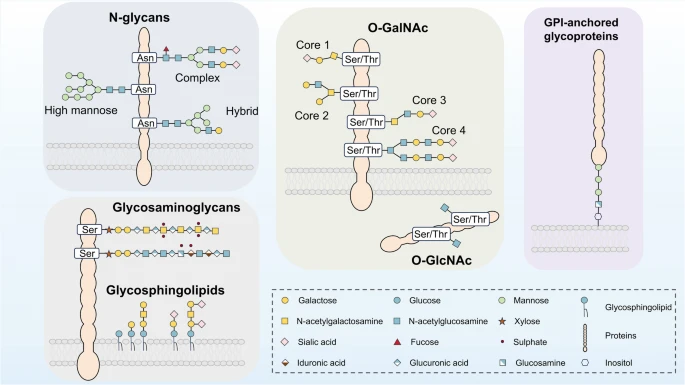
Classification of major manifestations of glycosylation on proteins.
Relevant Antibodies
| Catalog# | Product Name | Application | Reactivity |
|---|---|---|---|
| AMRe86358 | S Tag (DGR18447) Rabbit mAb | WB | Transfected |
| AMRe13855 | MGEA5 (10M9) Rabbit Monoclonal Antibody | WB,IHC-P,IP,IF-P | Human |
| APS0635 | HRP-conjugated Polyclonal Goat Anti-Rabbit IgG(H+L) Secondary Antibody | ELISA,WB,Dotblot | Mouse |
| AMRe80004 | GAPDH (12R9) Rabbit Monoclonal Antibody | WB,ELISA | Human,Mouse,Rat,Rabbit,Dog,Monkey |
Related Products
- Antibody Labeling Kit
- Western Blot Kits
- Super-sensitive ECL chemiluminescent reagent
- IHC Kit
- TSA mIHC Kits
References
- Comer, F.I. et al. (2001) Anal Biochem 293, 169-77.
- Slawson, C. and Hart, G.W. (2011) Nat Rev Cancer 11, 678-84.
- Capotosti, F. et al. (2011) Cell 144, 376-88.
- Hart, G.W. et al. (2007) Nature 446, 1017-22.
- Wani, W.Y. et al. (2017) Brain Res Bull 133, 80-87.
- Yang, X. and Qian, K. (2017) Nat Rev Mol Cell Biol 18, 452-465.
- Saha, A. et al. (2021) Chem Soc Rev 50, 10451-10485.
- He, M. et al. (2024) Sig Transduct Target Ther 9, 194.
 | Voisey Voisey is a technical support specialist at EnkiLife, proficient in immunology and cell biology. She is committed to providing customers with professional and efficient technical support. Additionally, she is involved in research on customers' fields of study and designs highly cost-effective solutions for them. |